Thursday, January 17, 2013

Review of David Schloen’s The House of the Father as Fact and Symbol: Patrimonialism in Ugarit and the Ancient Near East (2001)

The weirdly conservative world of J. David Schloen
In Roland Boer's Blog
As part of my sacred economy project, I have finally finished working through J. David Schloen’s The House of the Father as Fact and Symbol: Patrimonialism in Ugarit and the Ancient Near East (2001). It is eminently useful, obsessive, rambling, conservative, and ultimately flawed. The basic thesis is that Max Weber’s patrimonialism (patronage) is a valid category for understanding the politics and economies of pretty much every society in the ancient Near East, at least until the ‘Axial Age’ in the first millennium when ‘rationalisation’ began. He also deploys Paul Ricoeur for his theoretical armoury in order to provide what he feels is a ‘dialectic’ between fact and symbol (it is really more of a wooden correlation)...

Read the rest.

Thursday, January 10, 2013

Oppenheim Papers at Regenstein Library

Announced today by The University of Chicago Library Special Collections Research Center is the new Guide to the Adolf Leo and Elizabeth Oppenheim Papers 1988-1980.

Descriptive Summary

Title:Oppenheim, Adolf Leo and Elizabeth. Papers
Dates:1988-1980
Size:.25 linear feet (1 box)
Repository: Special Collections Research Center
University of Chicago Library
1100 East 57th Street
Chicago, Illinois 60637 U.S.A.
Abstract:This collection consists of documents relating to the lives of Leo and Elizabeth Oppenheim. A majority of the documents and correspondence relate to the couple's sustained attempts to leave Europe and immigrate to the United States during World War II. Documents within this collection date from 1888 to 1980, with the bulk of the documents dating between 1938 and 1946
 An interesting autobiographical sketch by Elizabeth Oppenheim can be found here.  From Robert Oswalts Preface:
Elizabeth Oppenheim, or Lilly as her friends called her, was invited sometime in 1978 to speak to a women's group in Berkeley on her escape from Nazi-occupied Austria and later from France. She prepared for this talk by writing out a 4,000-word account entitled, "Emigration history of A. Leo Oppenheim (1904-1974) and Elizabeth Oppenheim (nee Munk)." I had been intrigued by this chronicle and wanted to know more of the details of how she and her husband had managed to survive, and thus, at intervals in the period from about 1989 to 1990, when she was a bed-bound invalid but had not yet lost her ability to speak, we went over each item in her account, I asking questions and she answering as well as she Could -- much had been forgotten, but many new incidents were revealed. The questioning also turned to the happier days in Austria before the Anschluss and to her childhood and family background and, at the other end of her life, to the progress of the careers of herself and her husband. The account illustrates very well that in perilous situations survival often depends upon getting help from friends and other concerned persons, especially those with influence. It also depends on one's own resourcefulness, and depicted here is a remarkably resourceful woman who, as a foreigner, was not allowed to work in France at a steady job, even for minimal subsistence, and yet found a way to turn her artistic skills into a modest livelihood; and who, when living at the poverty level on first arrival in America, turned these same skills to increasing their joint income so that she and her husband could rise to a successful and comfortable life.
The information gained in the interviews was taken down as a 100 or so short notes. Since Lilly's death, I have sorted them and interfiled them chronologically with the paragraphs from her own account. Her original text is reproduced in italics; the additions are in ordinary typeface and are cast in the first person and worded to blend with the original sketch. Lilly's 1978 account is the more gripping story and whoever wants only her text can read the italicized portions of what follows. In editing the additions, however, I have followed the principle that, rather than cut out some parts to make a tighter adventure story, it is preferable to retain all information, as this is the only record of much of Lilly's life.
 And see:
Oppenheim, Adolf Leo at CDLI 
A. Leo Oppenheim in Wikipedia

And of course Erica Reiner's chapter A. Leo Oppenheim in Shils, Edward. 1991. Remembering the University of Chicago: teachers, scientists, and scholars. Chicago: University of Chicago Press.To the best of my knowlege this is not available online


Monday, January 7, 2013

Praise for the OI's Open Access Policy

Adam McCollum of the Hill Museum & Manuscript Library (HMML), Saint John’s University writes in hmmlorientalia:

Two important Syriac books from OI (Chicago)
For some time the Oriental Institute of the University of Chicago has very generously made available PDFs of its great store of books in Egyptology, Assyriology, archaeology, history, etc. Very recently the accessibility of two books of definite interest for Syriac scholars have been announced:
This is part I, but that is all that appeared. The only complete edition is that from the Bar-Hebraeus Verlag, 2003. Full information on manuscripts, editions, and studies will be found in Hidemi Takahashi’s always handy Barhebraeus: A Bio-Bibliography (Piscataway, 2005), 147-173.
Lagarde, with his interest in the Greek versions of the Hebrew Bible had worked on this Syriac text before and published it (as he did for other works) in Hebrew script (see here for bibliography of Epiphanios in Syriac). I cannot refrain from quoting Sprengling’s humorous report (p. ix) on Lagarde:
…our last predecessor in a similar undertaking [work on the Syriac Bible], the curious Paul de Lagarde of Göttingen. Lagarde had therefore undertaken an extensive study and a series of editions of this Epiphanius material. In his usual fashion he scattered this work around in a series of odd publications, many of them in small editions. These are not easy to get and, when obtained, generally not easy to use. The Syriac text, for example, he printed in Hebrew letters, because there was no Syriac type in Göttingen. His translation into German is curious. In various notes voicing his disgust and alleging (a thing Lagarde does not often admit) his incompetence, he shows that this was to him no labor of love. Jülicher’s statement in Pauly-Wissowa that the text is “sehr schlect ediert” by Lagarde is, indeed, too harsh a judgement. But a better, more easily accessible, more usable, and in every way more definitive edition than that of Lagarde, dated 1880, was clearly called for.
Hence the book by Dean, now eminently accessible after not being so for many years.
The Greek fragments of Epiphanios’ work (CPG 3746, cf. 3747) are not all that remains in addition to the Syriac: Georgian (CSCO 460-461, by M. van Esbroeck) and Armenian (CSCO 583, by M. Stone and R. Ervine) witnesses have also been published since the time of Dean’s Syriac text. In this work, interesting in and of itself, we have another opportunity for cross-linguistic comparison.


So, hats off to the OI for sharing its resources!

Thursday, December 27, 2012

The Fiery Furnaces "My Egypian Grammar"

The Fiery Furnaces have a song My Egyptian Grammar on  their album Widow City:

You'll find the lyrics over here.
I never thought it could have happened to me.
But on the morning of my eldest daughter's
Second wedding, I blacked out.
They said it was just stress, but I didn't think so:
 
I couldn't remember the 15 minutes before.
A white-haired half Samoan girl from Darwin
Gave me a ride, it seems; she let me the car in.
But what it was she said, I couldn't say.
 
Now, that clearly didn't happen. I consulted my Egyptian Grammar.
On p. 333 was the hieroglyph for motorcycle helmet.
 
I combined this with a leather-back's shell as I felt I was instructed.
I Xeroxed it and posted it down by the bike lock-ups at the Oriental Institute.
Maybe a nether-world entity would see it and pass it on to those responsible.
That kind of thing must happen sometimes.
 
Now that clearly didn't happen. I consulted by Egyptian Grammar.
On p. 428 was the hieroglyph for French Canal boat.
 
I met on the Midway someone channeling up a whatever it wasn't:
There are 17 sections of cymbals in the orchestra of the oversold, it said.
Your youth is lost and doesn't it now seem
You can't make smoke--only steam?
 
Now that clearly didn't happen. I consulted my Egyptian Grammar.
On p. 566 was the hieroglyph for a blue jay.
 There must be a back story.  Who can help?

H/T to TS

Wednesday, December 19, 2012

News: Paging Dr. Jones

Indiana Jones materials to appear on display at Oriental Institute Museum
William Harms
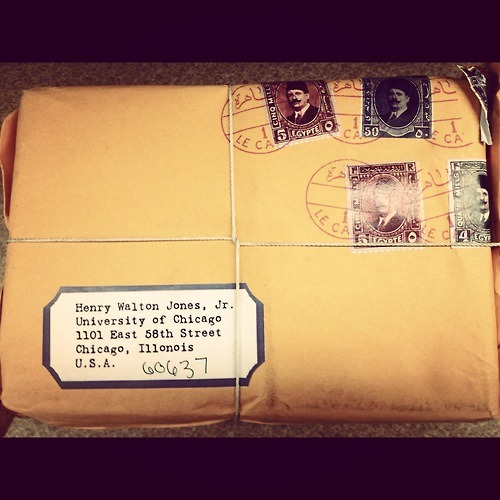
The contents of a package of Indiana Jones material that mysteriously arrived at the University of Chicago will be on display beginning Thursday, Dec. 20 and continuing through February in the lobby of the Oriental Institute Museum.

The mystery began Dec. 12, when a package addressed to “Henry Walton Jones, Jr.” arrived at the University of Chicago Admissions Office.

A student worker realized that the package was meant for Dr. Indiana Jones, the famous archaeologist of Raiders of the Lost Ark fame. Inside the package was a journal of Abner Ravenwood, the fictional UChicago professor who trained Indiana Jones...
 http://25.media.tumblr.com/2c083939e991f7dcfae2ee257a684dc2/tumblr_mevtbcBvWC1r0p8d9o2_500.jpg
This story broke on the University of Chicago Admissions blog: Indiana Jones Mystery Package.  It was solved a few days later: Mischief Managed.

See the chronicle of news about the Oriental Institute.

Monday, December 17, 2012

The changing neighbohood

Some interesting visualizations of what the neighborhood of the Oriental Institute will be like once the renovation and landscaping of the Becker Friedman Institute is complete are here.

http://img841.imageshack.us/img841/4712/4aed53e5.jpg 

And the Hyde Park Herald has some background on the University of Chicago Woodlawn Avenue Plan.

Sunday, November 25, 2012

Manning on Abt on Breasted

Joe Manning blogs a Brief review of Jeffrey Abt’s bio of James Henry Breasted

https://encrypted-tbn2.gstatic.com/images?q=tbn:ANd9GcRWayJL5PMvg9PaMacyuarlkvPXEHKUWyKVUa9ncaSJ2QmVwtk4Vw

ASOR Reception at the OI

"Gala Reception at the Oriental Institute at the University of Chicago that was held on Thursday evening (November 15th, 2012). The Oriental Institute opened its doors to ASOR and provided a lavish spread for the reception.  ASOR provided coach transportation to more to 350 attendees, and everyone had a wonderful time. Special thanks go to Gil Stein, director of the Oriental Institute, and to all of the staff. A highlight of the evening was the public announcement by ASOR of its “Building a Foundation for ASOR Campaign—Preserving the Past, Securing the Future.” This $1.3 million campaign will focus on endowment support, research and training support, and online resources. President Tim Harrison announced that ASOR has just passed the halfway mark with $670,000 in gifts and pledges, and we plan to complete the campaign by June 30, 2014 (the end of Fiscal Year 2014)".

The following are a selection of photos from the Gala Reception at the Oriental Institute:


Tuesday, September 18, 2012

New Special Exhibit, "Between Heaven & Earth: Birds In Ancient Egypt," October 16, 2012 – July 28, 2013

What's New
The Oriental Institute Museum announces its new Special Exhibit, "Between Heaven & Earth: Birds In Ancient Egypt," which opens from October 16, 2012 – July 28, 2013. Visitors to the Oriental Institute Museum will be able to step back in time to discover the world of birds in ancient Egypt as they stroll through an exhibit that recreates the feel of a marsh from the Nile, and see videos of birds flying overhead while the sounds of birds calling to each other resonate in the gallery.

The Oriental Institute Museum announces the re-publication of two short articles from this summer's News & Notes quarterly publication, both pertaining to the Museum's new Special Exhibit, "Between Heaven & Earth: Birds In Ancient Egypt," which opens from October 16, 2012 – July 28, 2013. These two articles highlight the various stages of learning and work involved in preparing several of the artifacts for exhibition in the show. 

Mission Statement of the Oriental Institute Museum and the Department of Public Education and Outreach

The Mission Statement of the Oriental Institute Museum and the Department of Public Education and Outreach is now available on its website.

Mission Statement

Within the Oriental Institute, the Oriental Institute Museum and Department of Public Education and Outreach promote interest in and understanding of ancient civilizations of the Middle East, and their connections to the modern world, for a broad and diverse audience. In order to tell the story of the rise of civilizations, communicate the excitement of archaeological, linguistic, and historical discovery, enhance understanding and appreciation of cultural similarities and differences, show connections between the ancient and modern worlds, and highlight the research of the Oriental Institute:
  • We preserve our collections and information about them
  • We facilitate and conduct research related to the collections
  • We educate our general and scholarly audiences through informative and engaging exhibits, programs, publications and website.
Read the rest here